

Section 301 Tariffs: What Drayage Carriers Can Expect for the Upcoming Shopping Seasons
The latest round, a fresh set of Section 301 tariffs that landed on July 24, replaced the temporary Section 122
The latest round, a fresh set of Section 301 tariffs that landed on July 24, replaced the temporary Section 122

West Coast vs. East Coast: The Impact of the New Tariffs on Different Ports On July 24th, the Section 122
What is Point-to-Point Pricing? Point-to-point pricing assigns a rate to a specific origin-destination pair, rather
For: New dispatchers, owner-operators

Pricing a lane you know cold is hard enough. Pricing a lane you have never run — a new terminal, an unfamiliar delivery zone, a customer handing you a zip code you have never served — is where a lot of carriers leave money on the table or, worse, take work that actively costs them.
This guide walks through a repeatable five-step framework for building a rate on an unfamiliar drayage lane. It is designed for new dispatchers and owner-operators who need a systematic process they can apply under pressure, when a customer needs a number in two hours and gut instinct is not enough.
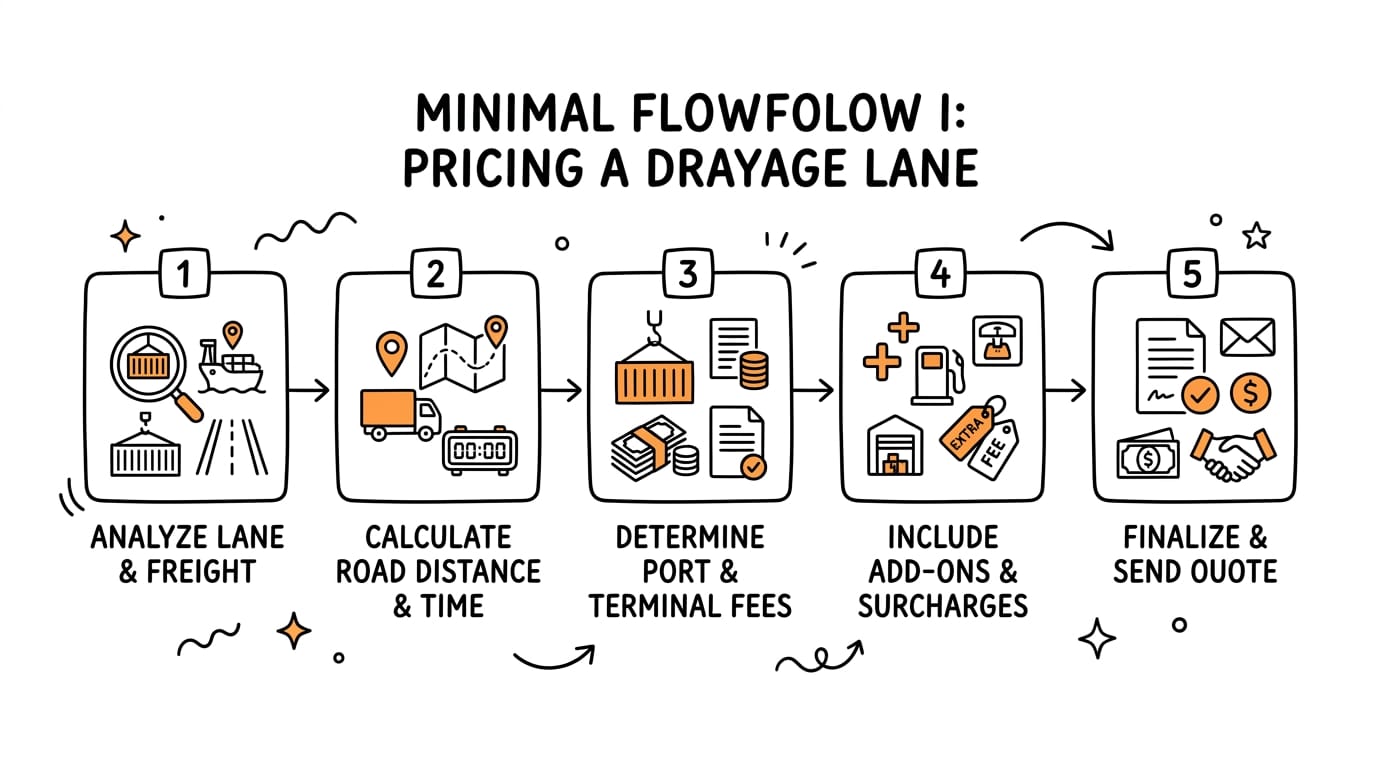
The drayage business runs on precision. Unlike long-haul trucking, where a few cents per mile of error gets absorbed across hundreds of miles, drayage margins are compressed into short distances. A $40 misjudgment on a 20-mile move is a much bigger percentage hit than the same error on a 500-mile load.
Unfamiliar lanes carry several specific risk categories:
The carriers who get burned on new lanes are rarely the ones who were careless. They are usually the ones who were fast. Speed without a framework is where margin disappears.
Before you calculate a single dollar, spend 15 minutes understanding the origin point. Not all terminals are equal — gate hours, appointment availability, congestion patterns, and chassis access vary significantly between facilities, even at the same port complex.
Key questions to answer:
If you dispatch through LA/LGB regularly, you already know that the difference between a smooth run at LBCT and a grinding day at a congested terminal across the complex can be 45 minutes of uncompensated driver time. Build that knowledge into your rate, not your post-delivery invoice dispute.
For terminals you have never used, call ahead. Ask the terminal's trucker services line about current conditions. Ask fellow dispatchers in your network. Five minutes of phone calls can prevent a $200 mistake on a $350 move.
Do not use a straight-line distance estimate. Do not rely on a shipper's description of how far the delivery site is from the port. Run the actual route through a routing tool — ideally one that accounts for truck restrictions — and document it.
For toll costs, be specific. Bay Area runs can add $15–$30 in bridge tolls per move. New York/New Jersey runs can add $50 or more in bridge and tunnel fees. Chicago area lanes may have I-Pass or Tollway costs that vary significantly by route. If you are quoting a lane that crosses toll infrastructure you have not priced before, look it up and add it line by line to your cost build.
This step matters beyond your rate quote. Mileage is the foundation for your fuel calculation in Step 3, so inaccuracy here compounds into your total cost estimate. A dispatcher who consistently underestimates mileage by 10% is systematically underpricing every lane they touch.
Also consider the return leg. If your driver will deadhead back to the port or to a chassis depot, that distance costs fuel and time even though it generates no revenue. A 40-mile loaded move that requires a 30-mile repositioning deadhead is effectively a 70-mile operational cost on a 40-mile revenue move.
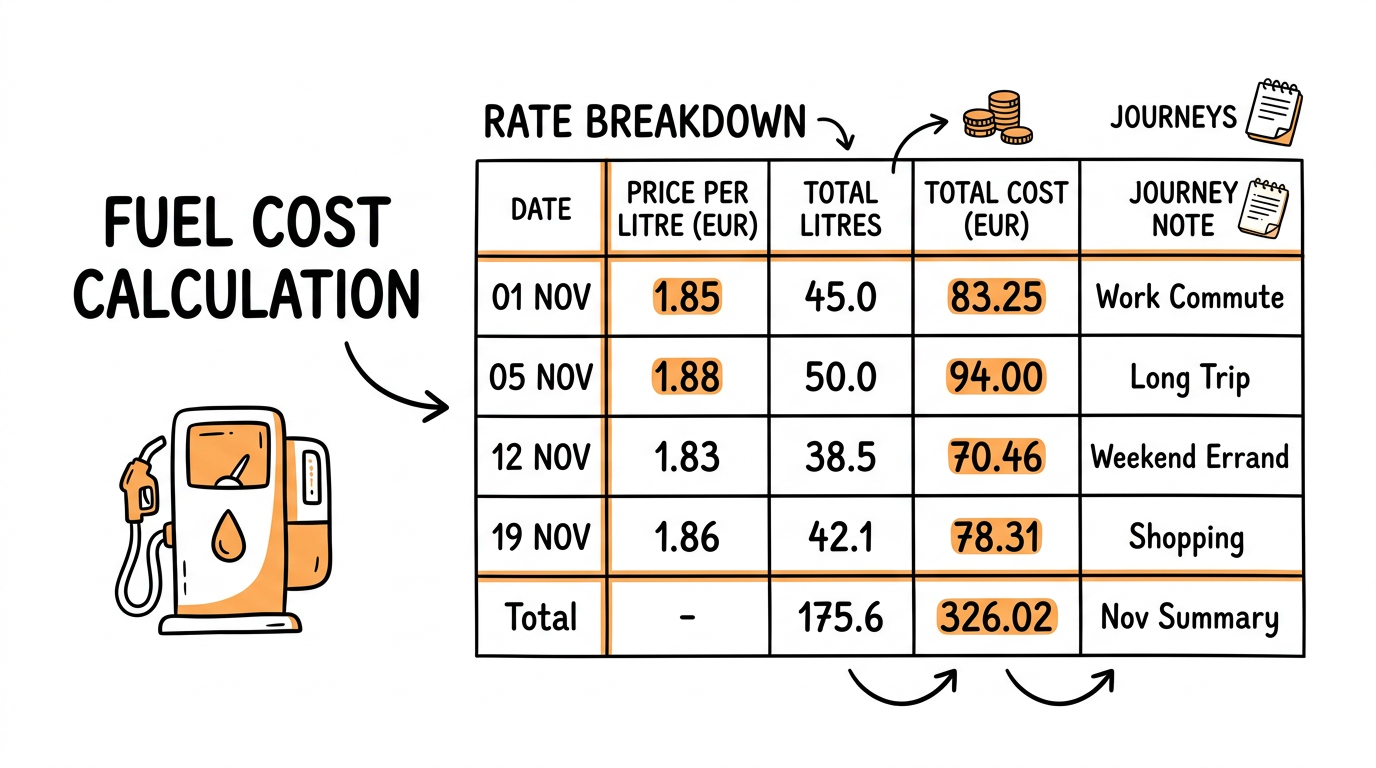
Fuel typically represents 35–40% of total drayage cost. At current diesel prices around $3.80 per gallon (national average as of mid-2026), this is a significant cost component that demands a current-data calculation, not a rule of thumb from six months ago.
The basic formula:
Fuel Cost = (Total Miles / MPG) x Diesel Price Per Gallon
For a typical drayage truck running at 6.5 MPG:
Add your fuel surcharge on top if it is a pass-through, or verify that your base rate already accounts for it. If you are using a DOE-indexed fuel surcharge formula, make sure the index you are applying reflects current conditions — stale index dates are one of the most common sources of underrecovery in drayage operations.
Do not forget that fuel costs fluctuate. If you are quoting a contract that will run for 90 days, ask yourself whether your rate holds up if diesel moves from $3.80 to $4.10. On a high-volume lane, a $0.30/gallon swing can represent several hundred dollars per month in unrecovered cost. Either build a fuel adjustment clause into the contract or price toward the higher end of the reasonable fuel range.
This is the step that separates experienced dispatchers from those still learning the business. Accessorials on an unfamiliar lane are unknown quantities — which means you need to price in a probability-weighted buffer based on realistic expectations for your operating environment.
Chassis split fee: If you are unsure about chassis availability at the origin terminal, add $50 as a buffer. If you know the terminal has chronic shortages — as LA/LGB terminals have experienced throughout 2026 — make it $65–$75. These are real fees that will hit your settlement sheet and that your customer agreed to pay only if you explicitly put them in your quote.
Detention: Standard detention rates run $75–$150 per hour after the free time window (typically 1–2 hours). On an unfamiliar delivery site, you have no track record of how long they take to unload. Add at least one hour of detention probability to your cost model for new customers and new delivery locations. If the customer is a distribution center or a large retailer with documented dock appointment systems, you can be more precise. If they are a small manufacturer or a first-time shipper of containers, be conservative.
Overweight and hazmat: If the container weight is near DOT limits, or if the commodity has any hazmat classification, build those fees into your quote explicitly or flag them before you commit. A carrier who discovers an overweight container at the gate after quoting a standard rate has a bad day ahead of them.
Per diem and storage: If cargo availability is uncertain — the container has not been discharged yet, the shipper has not confirmed pickup date — add a per diem buffer. Ocean carrier per diem schedules typically run $75–$150 per day after free time expires. If the drayage move is delayed due to customer scheduling, you need to know in advance whether that cost falls on you or them.
A practical approach for new lanes with new customers: add $75–$100 as a documented "new lane service buffer" and tell yourself you will refine it after two or three moves when you have actual operational data to replace the estimate.
After stacking all your cost components — base linehaul, fuel, tolls, chassis buffer, accessorial probability buffer, deadhead — apply your target margin on top of the total.
Healthy drayage margins in a competitive market typically run 12–18%. Where you land within that range depends on:
Do not compress your margin because you are uncertain about the lane. Uncertainty is precisely a reason to maintain or slightly widen your margin, not shrink it. You are absorbing unknown risk, and risk absorption has economic value. A carrier who consistently bids unfamiliar lanes at the low end of their margin range and then discovers unexpected costs is funding their customers' logistics savings with their own profitability.
Build the rate. Show your math internally. Then make sure the final number is one you can defend both to your customer if they push back and to yourself if the move costs more than expected.
A cost-build rate is only half the picture. You also need to know whether your number is competitive. This is where market benchmarks become essential.
Look at comparable lanes in your operating area — same origin port, similar mileage band, similar commodity type. What are other carriers quoting? What have you priced similar moves at historically? If your cost-build produces a rate of $425 and the market for that lane is $380–$400, you have a problem that needs to be addressed on the cost side, not by cutting your margin below a sustainable level.
Conversely, if your cost-build comes in at $340 and the market is paying $420, that is margin you are leaving on the table by reflexively matching the lowest bid you have seen.
Dray Insight's market benchmarking tools let you compare your lane rates against aggregated market data for specific origin-destination pairs, giving you a reality check before you submit a quote. That kind of external validation is especially valuable on unfamiliar lanes where you do not have your own historical data as a reference point. Seeing that your rate is 8% below market on a lane you have never run is a useful signal — it either means your cost-build is missing something or that you have a genuine efficiency advantage worth capturing.
Forgetting detention. The most common and costly oversight on new lanes. New delivery locations, new customers, unfamiliar facilities — all of these elevate detention risk. An hour of detention at $100/hour on a $350 move is nearly a 30% margin hit. Price it in from the start.
Underestimating chassis splits. At LA/LGB in particular, chassis splits have become a near-routine cost in 2026. If your quote does not include a chassis line item, you are likely underpricing for that environment.
Using outdated fuel prices. Diesel has moved meaningfully in the past 18 months. Always use current rack prices or the most recent DOE weekly survey when building a rate. A dispatcher using fuel prices from three months ago is systematically mispricing every lane they touch.
Ignoring deadhead miles. Empty repositioning is a real operational cost. If your driver has to travel to pick up a chassis or reposition to the next load, that fuel and time belongs in your rate structure, not your operating expense report.
Accepting a customer's description of dwell time. Shippers routinely underestimate how long it takes to unload at their facilities. They are not lying — they simply are not watching the clock from the driver's perspective. Use your own judgment, ask specifically whether they run a dock appointment process, and factor in the answer.
Skipping the terminal research. Fifteen minutes of upfront research on a terminal you have never used is worth far more than the equivalent time spent disputing an unexpected charge after the fact.
Manually building a rate from scratch on every new lane is time-consuming and error-prone under the best conditions. Under pressure — when a customer needs a number in an hour and your dispatcher is already juggling three other conversations — the risk of a costly mistake goes up significantly.
Dray Insight automates the cost-build process by pulling in current diesel prices, calculating lane mileage with routing logic that accounts for truck-appropriate routes and toll infrastructure, and applying your configured accessorial schedule. Your dispatchers can generate a defensible, documented quote in minutes rather than running a 30-minute manual calculation.
For unfamiliar lanes specifically, the platform's benchmark comparison feature lets you see where your rate lands relative to market data for similar origin-destination pairs. That combination — accurate cost build plus real market context — is what separates consistent, confident pricing from guesswork.
As you build a history of moves on lanes that were once unfamiliar, Dray Insight captures the actual outcomes: what detention ran, whether chassis splits occurred, how long the move took. Over time, that data replaces uncertainty buffers with real numbers, and your pricing gets sharper without getting riskier.
Pricing an unfamiliar lane well the first time is the difference between building a profitable customer relationship and subsidizing a shipper's logistics costs at your own expense. Use the framework. Do the work. And when you win the lane, log what actually happened — because next time, it will not be unfamiliar anymore.
Ready to automate your lane pricing? Book a demo with Dray Insight and see how carriers are building accurate quotes in under five minutes.
Subscribe to the free newsletter and get market intel delivered straight to your inbox.