

Section 301 Tariffs: What Drayage Carriers Can Expect for the Upcoming Shopping Seasons
The latest round, a fresh set of Section 301 tariffs that landed on July 24, replaced the temporary Section 122
The latest round, a fresh set of Section 301 tariffs that landed on July 24, replaced the temporary Section 122

West Coast vs. East Coast: The Impact of the New Tariffs on Different Ports On July 24th, the Section 122
What is Point-to-Point Pricing? Point-to-point pricing assigns a rate to a specific origin-destination pair, rather
Drayage RFQs aren’t just about price. Learn how ocean carriers run bids, procurement’s real priorities, and strategies to win profitable contracts in 2025.

With 40+ years of experience in drayage RFQs, pricing, procurement, and negotiations, we’ve seen how ocean carriers really run RFQs—and it’s not what most drayage carriers expect.
Ask an ocean carrier’s procurement team what matters most in a drayage RFQ, and they’ll tell you two things: price and service.
On the surface, this seems straightforward. In reality, ocean carrier RFQs are about cost first, with service acting as a pass/fail filter—either you meet the service standard, or you don’t. If you do, you’re in the running. If not, you’re out. Once that hurdle is cleared, price becomes the single biggest deciding factor.
But that’s not the only game at play. Here’s what most drayage carriers don’t realize:
Even before an RFQ is sent out, decisions are already being shaped by forces carriers don’t see. The process may look like a structured cost analysis, but it’s heavily influenced by internal politics, data inconsistencies, and pre-set pricing expectations.
💡 Key takeaway: Winning an RFQ isn’t just about price—it’s about knowing when you’re a real contender and when you’re just a pricing benchmark.
Not all ocean carriers follow the same RFQ process. Some have structured procurement strategies, like the Six Sourcing Steps, while others rely on custom workflows, internal relationships, or past pricing trends.
Regardless of the approach, RFQs follow a similar structure:
RFQs exist to build a dataset of current pricing—but how that data is used depends on the scope of the RFQ.
💡 Key takeaway: In national RFQs, you're competing with large carriers offering broad cost reductions. In regional RFQs, service history and relationships carry more weight—but favoritism plays a role.
When an ocean carrier launches an RFQ, they invite a mix of providers to ensure competitive pricing. However, not all participants have a real shot at winning.
💡 Key takeaway: Some RFQs are not true opportunities. If you’re being used as a pricing benchmark, your bid won’t translate into real business.
Once responses are in, procurement teams analyze bids to see where they can cut costs.
💡 Key takeaway: RFQs don’t always lead to new business. If procurement doesn’t see the cost reductions they expect, they may cancel the RFQ or renegotiate terms.
Quote smarter, faster and better with Dray Insight's Quoting Tool. Users benefit from centralized quotes enabling teams to respond to customer with speed and profitability in every load.
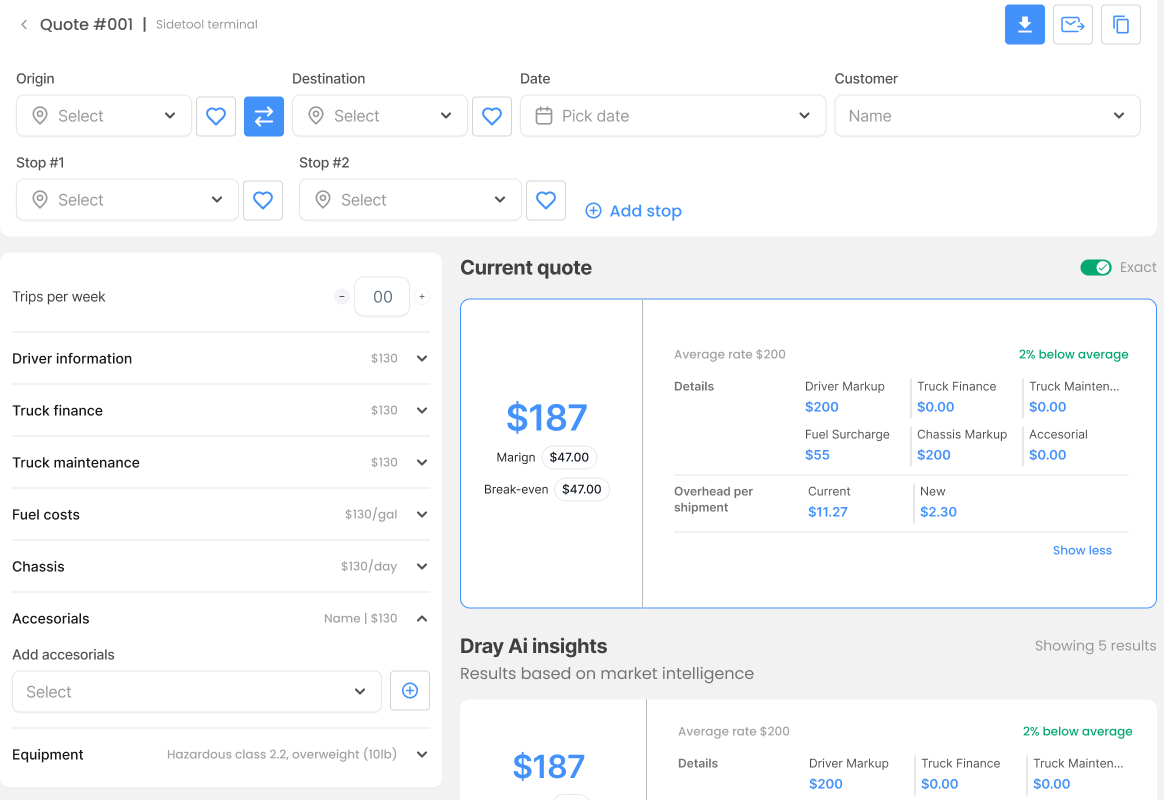
Understanding how RFQs are structured is one thing, but knowing how to price your bids profitably is another challenge altogether. Before you even think about responding to an RFQ, you need to ensure you can price your bid profitably. Ocean carriers will always prioritize cost, and without a clear understanding of your break-even rates, you could be bidding yourself into a money-losing contract.
Winning an RFQ doesn’t mean much if it doesn’t make you money. Without a strong grasp of costs and market conditions, carriers can end up in contracts that hurt their bottom line. Remember that RFQs are heavily cost focused, i.e. they will naturally lower rates or compress carriers into the lowest rate band available in the market.
💡 Key takeaway: If you don’t know your costs and the market, you’re either leaving money on the table or locking yourself into bad rates.
There’s a common military phrase: “The map is not the terrain.” The same applies to RFQs.
RFQs often contain flawed or misleading data, making it easy to submit a bid that looks good on paper but is unprofitable in reality. The issue isn’t just bad data—it’s that procurement teams rely on massive amounts of raw information from internal systems, making it difficult to translate into an accurate and usable RFQ format.
RFQs often present an idealized version of operations that doesn’t reflect real-world conditions. If you assume RFQ data is completely accurate, you risk:
Many RFQs ignore or underestimate accessorial charges like detention, chassis splits, and storage fees. This isn’t always intentional—procurement teams may lack full visibility into accessorial costs or assume they are already included in carrier pricing.
To protect your margins:
💡 Key takeaway: RFQs rarely account for all the operational costs you’ll face. Before bidding, challenge volume estimates, clarify accessorial terms, and ensure your bid reflects real-world conditions.
Volume Forecasting Is a Guess
💡 Key takeaway: Assume RFQ volume is an estimate. Lanes with higher volume will have better estimates than low-volume lanes.
💡 Key takeaway: RFQs don’t just compare rates—they compare total cost of ownership. If you have a relationship with the procurement team, ask how they will compare rates and carriers so your bid is competitive beyond purely price.
Carrier selection isn’t just about price—it’s shaped by an internal negotiation between procurement and operations.
Winning an RFQ isn’t just about offering the lowest price—it’s about understanding who actually influences the final decision.
💡 Key takeaway: Procurement wants reliable service but lacks consistent data to measure it. Since service is hard to score, decisions default to cost-driven comparisons unless operations raises concerns.
💡 Key takeaway: Operations understands that bad service creates hidden costs, but those costs often don’t show up in procurement’s financial models. Their pushback matters most in regional RFQs, where local relationships and execution are critical.
Once bids are submitted, ocean carriers use various tactics to drive rates lower and optimize their networks. Understanding these strategies helps avoid unnecessary price cuts and prevents getting locked into unsustainable bids.
Before an RFQ is even issued, procurement often sets pricing targets based on past rates and internal market intelligence. Sometimes, these targets are what’s known as ‘spaghetti rates’—arbitrary discounts thrown at the wall just to see what sticks.
These target rates act as an invisible ceiling—if procurement has already set an expectation for a 5% cost reduction, any bid above that might be dismissed outright, no matter your service quality.
💡Key takeaway: Procurement’s “target rates” aren’t always based on real cost factors—they’re often designed to pressure carriers into lower bids.
Some RFQs invite carriers to re-bid in real time against competitors. This is designed to create a race to the bottom, where carriers feel pressured to keep cutting rates just to stay competitive.
But here’s the catch:
In many cases, procurement will use the lowest bid to negotiate down other providers, meaning you may still lose the lane while driving down the entire market rate.
💡Key takeaway: If you’re participating in a live auction, set a floor price in advance. When you hit your walk-away point, walk away!
Ocean carriers frequently package profitable and unprofitable lanes together to lower their network costs.
Carriers often accept loss leaders (unprofitable lanes) expecting volume to balance them out—but if that volume never comes, they’re stuck.
💡 Key takeaway: If you take on a loss leader, be sure you can absorb the loss—or you may end up with only the bad lanes and none of the profitable ones. If you’re a small to mid-sized carrier, loss leaders are a gamble you can’t afford. Without guaranteed volume, you could end up servicing only the worst lanes.
The ongoing freight market downturn shows no structural signs of relief. Spot rates remain weak, capacity is still outpacing demand, and even contract freight is seeing downward pressure. On top of that, new tariffs could create additional cost volatility, forcing shippers to reassess their supply chains and potentially driving procurement teams to squeeze drayage rates even further.
In short: Margins are shrinking, and RFQs will still be challenged in 2025.
With procurement teams already favoring cost over service, carriers that don’t price correctly in annual bids risk locking themselves into unprofitable shipments for an entire contract cycle. If you’re not careful, a bad RFQ bid could leave you running lanes at a loss while fuel, labor, and accessorial costs continue to climb.
💡 Key takeaway: 2025 is shaping up to be an even tougher RFQ cycle, with downward pricing pressure, weak market fundamentals, and tariff-related cost risks. The carriers that survive will be the ones that price smarter, walk away from bad bids, and use data to defend their margins.

Learn how to calculate drayage rates by factoring in overhead costs and margin analysis. Protect your profits by pricing with accuracy and confidence.

Turning RFQ Wins Into Profitable, Sustainable Drayage Operations Winning a drayage RFQ feels like a win—but it’s really

Introduction: The Overlooked Impact of Deregulation on Drayage When most people think of trucking deregulation, they immediately picture long-haul

Discover how Liberty ships powered WWII logistics and how Malcolm McLean's container shipping revolutionized global trade. A journey through maritime history.
Subscribe to the free newsletter and get market intel delivered straight to your inbox.